


About the project
The research group on Theoderic of Verona at the Department of Foreign Languages and Literatures of the University of Verona, established within the framework of the Departmental Project of Excellence 2023–2027 on Inclusive Humanities, aims to promote and enhance one of the most renowned legendary heroes of medieval and post-medieval Germanic traditions.
To this end, the group carries out both scholarly activities (conferences, seminars, publications) and outreach initiatives, with particular emphasis on the dissemination of knowledge through digital media. In line with the objectives of the Inclusive Humanities project, this website and its digital contents are designed with particular attention to inclusion and accessibility, with the aim of reaching a broad and diverse audience in terms of expertise, needs and specific requirements, as well as linguistic and cultural background.
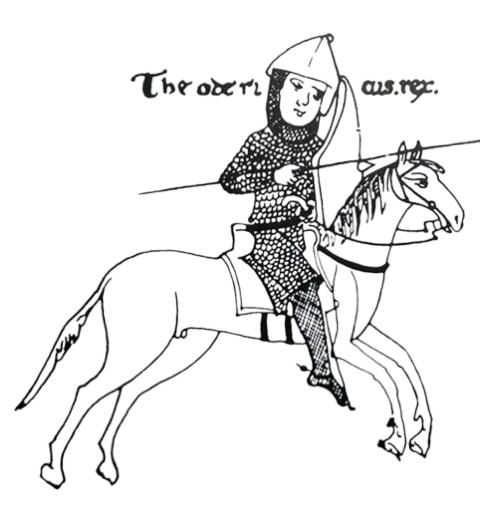
The legendary hero known as Theoderic of Verona derives from the transformation of the Ostrogothic king Theoderic the Great (ca. 453–526), whose 1500th anniversary is commemorated this year. In the Germanic vernacular traditions, the hero appears under the name Dietrich von Bern, where the toponym Bern refers to the city of Verona, which had been one of the preferred residences of the Ostrogothic ruler. In medieval Germanic literatures, the hero appears very early in foundational texts: one need only think of the Hildebrandslied, copied at Fulda (in present-day Hesse, Germany) in the early decades of the ninth century, which constitutes the earliest testimony of heroic poetry in the German language and one of the earliest within the entire Germanic linguistic and cultural sphere.
In the Lied, the anonymous poet narrates the encounter between the aged Hildebrand, Theoderic’s master and companion-in-arms, and Hadubrand, a young warrior serving in the army of Odoacer, in whom Hildebrand recognizes his son. The text, which lacks its ending, conveys the essential elements of the Theoderic legend, shaped through processes of synchronization, simplification, and personalization: it emerges that Theoderic is a king forced into exile after an enemy has usurped his kingdom. The historical adversary Odoacer, who still appears in the poem, is replaced in the legend by Ermanaric, a barbarian ruler who died in 375 AD, and who assumes the role of the hero’s cruel uncle, thereby transforming the political war into a family conflict. The thirty-year exile at the court of Attila is likewise a poetic invention: although the Hunnic king had died in the very years in which Theoderic was born, their association probably reflects the echo of an ancient alliance between the Ostrogoths and the Huns.
Learn more about the project: